Tuesday, 26 April 2011

DVD Review: Blame it on Fidel

When it played at the EIFF a few years ago I remember being less than impressed by the description of Blame it on Fidel in the programme (how I make my EIFF choices will be covered in a future post- I bet you can hardly wait).  As a result I decided to give it a miss and so I only got round to seeing it fairly recently.  It tells the story of a young girl, Anna, growing up in early 70s Paris whose parents embrace radical socialism.  The subsequent adjustments to their lifestyle- behavioural and material- naturally have a marked impact on her.

I think I was put off for two reasons: firstly I was fearful from the promotional comments that politically I would find it annoying.  I imagined a film full of gross caricatures of left activists, an over-simplification of ideas, and difficult to like characters.  To an extent this assumption turned out to have some justification.  Their house is soon full of barbudos who come out with such statements as "Mickey Mouse is a fascist" and "your child is a reactionary" while Anna and her brother feel themselves more and more neglected as a result of their parents' newfound priorities.

My second concern was given the subject matter and the fact that first time director Julie Gavras is the daughter of lefty director Costa-Gavras, that this could turn out to be a tad self-indulgent and that the lead character could be an unrealistic and overly sympathetic representative of her younger self.  On this I was most definitely wrong.  If anything, it's actually difficult to like the child at all to begin with given how spoilt and selfish she is at times.  As the film proceeds, however, we see an impressive level of complexity conveyed as Anna wrestles with her surroundings and education.  The scene where she puts into practice the lessons she's learned in solidarity is both touching and amusing.  It's in this more fundamental story, how children process and assimilate information and how ideas and experiences shape our perceptions, that the real interest lies and there's certainly enough here to make me look  forward to Gavras's next film, due out later this year.

Sunday, 24 April 2011

New Poll: Diabolical Attempts at a Scottish Accent

Well I enjoyed the last so I thought I'd give another poll a bash.  Before explaining what it's all about though, here are the results of our last poll- your favourite film set in Embra.

Greyfriars Bobby- 2%
The Prime of Miss Jean Brodie- 0%
Restless Natives- 20%
Hallam Foe- 5%
Shallow Grave- 12%
Trainspotting- 40%
The Illusionist- 20%

Congratulations to Trainspotting- a worthy winner.  I don't think many of us will be surprised by the result; I caught it on telly last night and was as struck by its energy and relentless pace as the first time I saw it.  Interestingly for a comparative newcomer, The Illusionist picked up a very respectable 20%.  I was also pleased for the more than respectable showing of Restless Natives.  Was it the Big Country soundtrack?  Was it the cityscapes of the less scenic areas of Edinburgh?  Was it the way that it deals with the unfulfilled desire for adventure that lies in all of us?  Or was it the ongoing plug in the banner of this page?

So what next?  Well, in keeping with the Scottish theme I wanted to look at an area that has long bugged me- piss-poor attempts at Scottish accents.  This is a very personal issue for me; growing up in Englandshire I had many an annoying day as school mates took the piss out of my accent.  When I would then hear an atrocious Scottish accent on telly or at the pictures then it felt like a continuation of the piss-take.

There's a few good examples, but which is the worst?


Harrison Ford
Indiana Jones and the Last Crusade
Best Line- "Wer her ta say tha tepistrees!"

I know it's not to be taken seriously but this really is poor.  Harrison Ford's 'Lord MacDonald' seems to have arrived in Austria via South Africa and possibly Russia.

Christopher Lambert
Highlander
Best Line- "Em Canner Mclewd af tha Clen Mclewd"

Fish in a barrel but he had a more convincing highland accent in Greystoke- the Legend of Tarzan.

Mel Gibson
Braveheart
Best Line- "Freeeeeeeedom"

I quite like this one actually but I am under the impression I'm in the minority.  I have more problems with his hair extensions.

Jessica Lang
Rob Roy
Best Line- "Though I love his honour, 'tis but a shadow to the love I bear him."

Could have had my pick from this film but have plumped for Oscar winner Lange's Norwegian inflected effort.

Robert Duval
A Shot at Glory
Best Line- "It was me who had his dorrterr stohlen from him"

Hands up who actually saw this.  I thought as much.  Watch the trailer and I'm sure you'll agree that he merits a place on the short list, even if he is overshadowed by a performance from young Ally McCoist so bad that he somehow convinced me he wasn't a jokey womaniser.


Honourable mentions to Mike Myers in Shrek, Robin Williams in Mrs Doubtfire and James Doohan in Star Trek.  If you can come up with better suggestions early on then I may be inclined to add them.

Cast your votes!

Tuesday, 19 April 2011

Normal Service Has Resumed

Apologies for the delay in posting my humble thoughts on all things film-related in sunny Embra.  I won't bore you with the reasons for the unplanned hiatus (although you can find some of my interim work contained here and here) but I'm now back and raring to go.  Or at least as much as I am ever raring.

Perhaps the first thing I need to get sorted is a new poll.  I'll do that later in the week but any suggestions?  I'm also about 20 films behind in my reviews so I'll need to address that in the next couple of weeks too.  

One of my most recent viewings was of the low-budget Scottish feature The Inheritance.  Made for just £5000, it got me thinking how easy it is nowadays for any numpty to produce a short film (see below for evidence).


This is obviously due in part to the ubiquity of cameras, either on our posh mobies or my own defunct Flip micro.  Equally as important, however, is the availability of easy-to-use editing software that requires neither the budget nor expertise that previously made film-making a more elite pursuit.

It was only a matter of time before people far more talented that me demonstrated the real potential in all this. There's now even an iPhone Film Festival accepting submissions, some of which are really quite impressive. Have a look at some of them at http://www.iphoneff.com/.  I might hold off on submitting mine for the time being.

Sunday, 13 March 2011

Women in Films

This interesting wee video was brought to my attention recently and I thought it was well worth sharing.  It's to do with the role of women in film or, perhaps more precisely, the way the male perspective dominates in cinema.  It's worth checking out the comments and some of the other links (I know Inge will enjoy the ones on Veronica Mars).


According to my little black book I have seen 21 films for the first time so far this year.  Of those, only 4 pass the test- Black Swan, Blame it on Fidel (review forthcoming), Unrelated (sort of review forthcoming), and Fish Tank (review forthcoming if I can be arsed- suffice to say if you haven't seen it then do so).


What's striking is not only the dearth of prominent roles that 50% of the population can identify with but also how we accept as 'normal' the dominance of the male narrative.  A James Bond film is as clear a commentary on masculinity as anything else (what man out there hasn't tried the pose) but we think of it as a kind of default entertainment, almost gender neutral and no reason why it shouldn't appeal to everyone.  Even when we see female leads, it is rare for men to be excluded entirely- the same cannot be said of the reverse.  

Part of the problem is the lack of women elsewhere in the industry.  Women make up only 7% of directors and of the 4 examples I gave above, 3 of them were the only films I have seen by female directors this year.  Things might be changing- of the Time Out 100 best British films referenced in a previous post there were 4 films by female directors, an improvement of 4 on the 1999 BFI poll and all of which were made in the last 20 years.  Some feel that the solution lies in the championing and funding of female writers and film-makers, with the closure of the UK Film Council making this more difficult.   There may be some merit in that but the fact that so many of us accept the secondary role of women in cinema is perhaps a reflection of wider societal attitudes.


Thursday, 10 March 2011

Review: True Grit

And not before time.  I've no idea why it's taken me so long to see this- I like the Coen brothers and modern takes on the western- but it was only last weekend I finally sat down and watched it.  Well worth the wait it was too with the biting black humour you come to expect from the Coens, wonderfully shot and a few frights thrown in.  It's surprising that it has garnered so few awards over the past few months, especially from the excellent performances from the cast.   Much has been said of Hailee Steinfeld's performance as Mattie Ross and she deserves the plaudits.  She sells every last syllable of what is at times pretty fast, complicated dialogue and is utterly convincing- tough and determined with just the right level of vulnerability.  As everyone else has said, Jeff Bridges is equally as impressive as Cogburn, the fact that you can only pick up every other world only adds to the authenticity of the character.  Matt Damon also deserves a mention as it's only through his interaction with them that the relationship between Mattie and Cogburn really works.

My friends and I were discussing the ending over a couple of drinks in the pub afterwards (Cloisters if you're wondering- if you don't know it then really should go some time and give me a shout).  One of them was wondering whether the epilogue was really necessary and I am certainly often critical of films that feel like they go on five or ten minutes too long (or in the case of the Stieg Larsson trilogy about 4 1/2 hours).  However, in this instance the epilogue really added something to our understanding of the film [SPOILER ALERT]; not only about how Hattie was shaped, physically and mentally, by the experience but also how Cogburn was.  He leaves the old ways behind, we don't know for certain why- maybe he feels too old, perhaps he came too close to death, for the first time maybe he felt a productive purpose in his life rather than a destructive one (when he replaces his horse I was reminded of Major's speech in Animal Farm "Man is the only creature that consumes without producing...he is too weak to pull the ploough, he cannot run fast enough to catch rabbits.")  Or perhaps times just change- the film ends not just with his death but that of the Wild West itself.

Anyway, well up there with the best of the Coen brothers and, for me, much more rewarding that the distinctly ok King's Speech.

Monday, 28 February 2011

Time Out 100 Best 'British' Films

A couple of weeks ago Time Out produced a list of the all time top 100 British films based on a poll of 150 actors, directors, writers and other industry insiders, and an entertaining list it is too.  As with any list of this type there are some inclusions that raise eyebrows (Dr No is the weakest of Terence Young's Bonds imho), omissions (Red Road, A Fish Called Wanda, A Man for All Seasons) and, I have to admit, a fair few with which I'm quite unfamiliar.

Joseph Cotton and Orson Welles running through Vienna
As I was reading through, however, I was surprised by the inclusion of some, in particular Walkabout and The Third Man, which I hadn't really thought of as 'British' films.  Fair enough, I thought, they have British directors, but then so does Gandhi and that's nowhere to be seen on the list.  Alexander Mackendrick's work is well represented but arguably his greatest film, The Sweet Smell of Success set in New York, is missing.  There are two pre-war Hitchcock films, but nothing from his career in Hollywood.  Would Inception or the new Batman films qualify as British by the definition of some contributors?

However, on looking through the list it appears that the nationality of the director doesn't really matter either-  Night And The City, Repulsion, and three Stanley Kubrick films have also been selected.  Confused, I scanned the site looking for what definition of 'British' they were working to only to find that they didn't have one.  That's fine but it did make me wonder what definition individual contributors were thinking of in making their selections.

Brigadoon: a Scottish film?
I then looked through to see how many Scottish films are included on the list but found the same problem- how should I define 'Scottish'?  The Bill Douglas Trilogy, Gregory's Girl, and even Local Hero I suppose are quite straightforward.  I think most Scots would accept Trainspotting, Whisky Galore, and probably Culloden too.  What about The Wicker Man?  The 39 Steps?  For that matter what about Braveheart or Brigadoon?

You'll notice in the poll on the right-hand side I've been careful in my wording.  They are not 'Embra films' but 'films set in Embra' precisely because I was sure there would be some pedant arguing that none of them were truly Edinburgh films.  With the exception of Hallam Foe, none of them have a Scottish director, never mind one from the city itself.

In an age where casts, crew, settings, and production are frequently international some might argue that it is pointless to think about films in terms of nationality.  I'd like to think otherwise.  Just as those films in the Middle East Festival told us something about their countries of origin, does Trainspotting and Restless Natives not do the same for Scotland, and Edinburgh in particular?  Is that the definition? 

Friday, 25 February 2011

Middle East Festival

Last weekend I had the pleasure of watching a couple of cracking films showing at the Edinburgh Filmhouse as part of its Middle Eastern Film Festival (in turn part of the larger Edinburgh International Festival of Middle Eastern Spirituality and Peace).  With the whole of the region (and beyond) entering a period of uncertainty and transition it was interesting to see some of its cinematic output from recent years.

First up was Captain Abu Raed, the first film to be produced in Jordan in 50 years.  Abu Raed, played by UK-based Nadim Sawalha, is an airport janitor nearing retirement who is leading a somewhat insular life following the death of his wife and son some years before.  Finding an airline captain's hat, Raed decides to wear it home which prompts the local kids to mistake him for a pilot.  Fighting against his instinct to ignore them, he goes along with it and regales them with stories of his imaginary foreign adventures which gradually leads him to come out of his shell and start to take an active interest in the lives of others, especially the children and a friendly female pilot.

While the music and use of fades and slo-mo leads the film to occasionally come across a little twee, it is still a highly enjoyable couple of hours.  Key to its success is the superb performance of Sawalha who makes it so easy to relate to and sympathise with Raed.  He wrestles with his decisions- whether to do nothing or to put himself to inconvenience and danger by helping others.  Doing the right thing is not always easy and instinctive- the dilemma is successfully conveyed without ever being oversold.

Sawalha was available for a Q&A after the screening and explained some of the background to the production and his relationship with his excellent child co-stars.  Interestingly he remarked that he liked that the film stays clear of overt references to religion and politics but that view seems at odds with some of the key themes that run throughout.  The film confronts issues of domestic abuse and gender equality as major plot points and class is broached in the same way.  "You can tell he's not an airline pilot," says one of the boys.  "People like us don't become pilots."


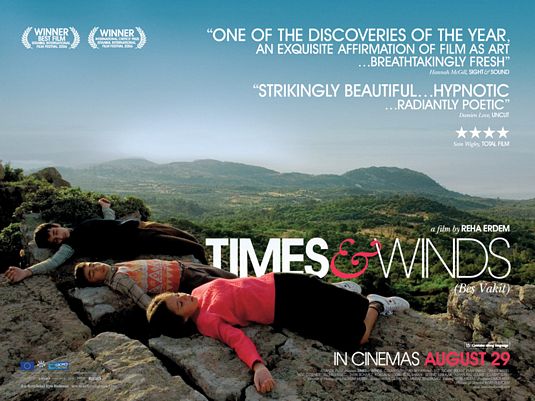
The second film I caught was Times and Winds from Turkey, a much slower work following the lives of four children, their families, and fellow villagers over the course of a year.  The picture opposite, showing off the stunning the scenery and the sleeping kids, is a great summary of what the film's about.  Over the course of a year, the kids encounter a lot of problems, some bigger than others but all of huge importance to them.  The landscape serves as an indication of their isolation which acts as a kind of prison, but its scale also reminds us that their problems are miniscule in a global context.  This is not to minimise how they feel, but is more a comment on how children in particular sometimes have difficulty putting things in perspective (although this is obviously not a trait confined to exclusively to children).


Like Captain Abu Raed there is a very forward-looking feel to the film.  The kids constantly find themselves in conflict with their elders and traditions although they don't fight against it and there are no value judgements placed on the village traditions.  The film ends on a spring morning with the children looking out beyond the sea- it's their choice what they do next.  As it is for millions across the region today.

A couple of days later I spotted in Fopp for just £7- well worth it.